Fraud Detection & Prevention Symposium: Increasing Collaboration and Driving Action
In February 2023, the Federal Chief Information Officers (CIO) Council hosted a “Fraud Detection & Prevention Symposium”. The day-long event featured over 20 executives, technologists, and changemakers from 10+ agencies, academia, and the private sector participating in the one-day event to discuss fraud issues as mentioned below that are impacting agencies. The event was well attended with nearly 300 participants.
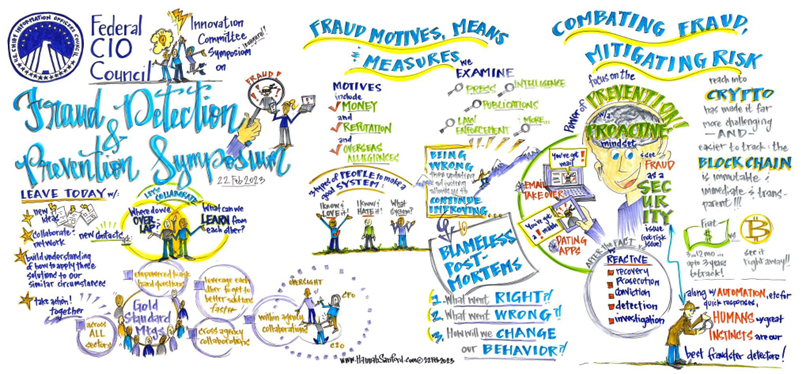
Managing and addressing fraud is critical to protecting our taxpayer resources and is a critical responsibility of the Federal Government. However, agencies vary in their ability to manage fraud risk. Ann Dunkin, CIO of the Department of Energy (DOE), opened the symposium with a call to action for participants and added, “Let’s not reinvent the wheel, but rather share best practices and solutions. We want to identify key points of contacts and experts in this space. So, let’s not be afraid to collaborate. We want to understand where gaps remain, and where technology solutions may be required.”
Increasing Collaboration Through Public-Private Sector Conversation
The symposium was designed to educate, inform, and enlighten participants on where fraud challenges have been addressed and how similar solutions could be applied at their organization. Agency representatives from the Social Security Administration (SSA), National Science Foundation (NSF), and the Internal Revenue Service (IRS) stressed the importance of documenting and sharing these techniques across the Federal Government and bringing people together to have focused discussion on specific mission challenges.
They informed attendees of the numerous cross-government fusion centers, such as the IRS Information Sharing and Analysis Center, where leads and patterns regarding fraud can be shared among members. Speakers reinforced the need for participants to view fraud as a cybersecurity threat as it may put all American’s data at risk.
Driving Action Through Data
Congress passed the Health Insurance Portability and Accountability Act of 1996 (HIPAA) to establish a national Health Care Fraud and Abuse Control Program (HCFAC). The scale and complexity of healthcare operations have attracted fraud and abuse. In 2019, federal law enforcement charged 35 people associated with telemedicine companies and cancer genetic testing laboratories (CGx) with fraudulently billing Medicare more than $2.1 billion for these CGx tests, this has been compounded by imperfect markets and state level differences.[1]
Representatives from the Drug Enforcement Agency (DEA), Health & Human Services-Office of the Inspector General (HHS-OIG), Centers for Medicare & Medicaid Services (CMS), and Department of Justice (DOJ) addressed how they are combating fraud with detection, prosecution, prevention, and impact.
They showcased how the departments are coordinating efforts around fraud detection and how they are using technology to bridge the gap between mission and impact. Once fraud, waste, or abuse are detected, DOJ and HHS must decide how to intervene. Given the limited resources available, participants heard how technology serves as an enabler to drive effective and efficient decision making. By using data analytics to identify patterns and trends, resources are better allocated across organizations.
Key Comments and Closing
“My hope is to crowdsource on these issues we are all talking about today and work together as we start this journey. We’re still in the discovery phase. We’re still trying to strike that right calibration in terms of what we want.” – Stephen Kucharski, Acting Chief Information Officer for the Small Business Administration.
“A great takeaway from this conference is the need for blameless post-mortem (discussions) and giving people the opportunity to fail. That’s how we actually learn as individuals. Getting this community together is the first step in driving our problem sets to solutions.” – Chris Brazier, Acting Deputy IT Director & Chief Technology Officer for the Defense Threat Reduction Agency.
“The challenge is how to stay nimble. The adversaries that all of us are facing are innovative. We need to be (more) innovative.” – Dr. Naomi Adaniya, Chief Data Officer for the Drug Enforcement Agency.
It’s imperative to get the best of the public and private sector together to have conversations and break down silos. In order to get different results, everyone must start thinking differently and this event was about just that. The CIO Council thanks all of those who joined. Stay tuned for future symposiums and if you have any questions, please contact ciocouncil.support@gsa.gov.
Related Posts
CISO Council and CDO Council Release Joint Guide on Federal Zero Trust Data Security
Today, the CISO Council and CDO Council released the Federal Zero Trust (ZT) Data Security Guide, a first-of-its-kind document and key deliverable of OMB M-22-09, Moving the U.S. Government Towards Zero Trust Cybersecurity Principles. M-22-09 charged the Federal CDO Council and Federal CISO Council to convene a cross-agency working group of data and security experts to develop a data security guide for Federal agencies.
Federal Tech Day 2023: Impact Through Innovation
The Federal Chief Information Officers (CIO) Council, in partnership with the U.S. Department of Labor and U.S. Department of Energy, hosted Federal Tech Day 2023 to showcase innovative technologies developed by federal agencies to help deliver their programs' missions.
CIO Council Releases Handbook for Small Agency CIOs and Executives
The Small Agency CIO Council published the Federal Small Agency CIO and IT Executive Handbook in partnership with GSA's IT Modernization division. Small agencies often have unique organizational structures that do not follow the traditional staffing model for IT administration. We recognized the importance of creating guidance specifically to meet the unique challenges faced by IT leaders in our small agency community. This handbook serves as a foundational guide to assist small agency IT Executives in carrying out their missions.